Each-Way Golf Betting Explained: Terms, Payouts and Strategy
 Available in US
Table of Contents
- Each-Way Golf Betting: Why E/W Is the UK Punter’s Favourite Golf Market
- How Each-Way Bets Work: Win Part and Place Part
- Place Terms Compared: 1/4 vs 1/5 Odds, Top 5 vs Top 8
- Calculating Your Each-Way Payout Step by Step
- Dead Heat in Each-Way Golf Bets: A Brief Overview
- E/W Strategy: When Each-Way Adds Value and When It Does Not
- Each-Way Betting In-Play: How Terms Shift During a Tournament
- Each-Way Golf Betting Questions
- Making Each-Way Work Harder for You
Each-Way Golf Betting: Why E/W Is the UK Punter’s Favourite Golf Market
I remember the exact moment I fell in love with each-way golf betting. It was the 2015 Open Championship at St Andrews, and I had backed a 66/1 outsider each-way at 1/5 odds, top 8. He did not win – he finished seventh. But when I checked my returns, the place part alone paid more than ten times my total stake. That single bet taught me something most punters take years to learn: in a sport where the outright winner comes from a field of 144, the place payout is not a consolation prize. It is the main event.
Each-way golf betting is the most popular market among UK punters for a reason that goes beyond tradition. Golf’s field size creates a brutal mathematical problem for outright betting – even the world’s best player loses roughly 90% of the tournaments he enters. E/W addresses that problem directly by paying on a range of finishing positions, transforming a high-variance gamble into a more structured wager with multiple paths to a return. Golf betting in the UK accounts for 1.2% of gross gaming revenue and has grown by 30.7% since 2021, and a significant share of that growth comes from punters who have discovered that E/W terms on golf are among the most generous in any sport.
This guide covers everything you need to place each-way golf bets with confidence: how the two-part structure works, how place terms affect your return, step-by-step payout calculations including dead heats, and a strategy framework for identifying when E/W adds genuine value versus when you are better off splitting your bet or going outright. Every example uses realistic numbers from actual market conditions.
How Each-Way Bets Work: Win Part and Place Part
A few years back, a friend told me he had placed “a tenner each-way” on a golfer at 40/1. When I asked him what his total outlay was, he said ten pounds. He was genuinely surprised when I explained he had actually spent twenty. That confusion – thinking “each-way” is a single bet at a single price – is the most common misunderstanding in golf betting, and it costs new punters money every week.
An each-way bet is two separate bets of equal size. The first is a win bet at the full advertised odds. The second is a place bet at a fraction of those odds, contingent on the player finishing within a specified number of positions. When you place £10 each-way at 40/1, you are staking £10 on the player to win (at 40/1) and £10 on the player to place (at a fraction of 40/1 determined by the bookmaker’s terms). Your total outlay is £20.
If the player wins, both parts pay out. The win part returns £410 (£10 x 40, plus your £10 stake). The place part also pays out because the winner has, by definition, placed. At 1/5 odds, the place part returns £90 (£10 x 8/1, plus your £10 stake). Your total return on a winning £10 each-way bet at 40/1 with 1/5 terms is £500 – £410 from the win part and £90 from the place part.
If the player finishes in a place position but does not win, only the place part pays out. Your £10 win bet is lost. The place part returns depend on the fractional terms and the original odds. At 40/1 with 1/5 terms, a place finish returns £90 – enough to cover your total £20 outlay and generate a £70 profit. That asymmetry, where a place-only finish can still produce a healthy return on long-odds selections, is why E/W is so well suited to golf’s wide-open fields.
If the player finishes outside the place positions, both bets lose and your entire £20 stake is gone. There is no partial refund, no graduated payout – it is all or nothing on the place threshold. This binary outcome makes the place terms the single most important variable in an each-way bet, which is why the next section focuses on them in detail.

Place Terms Compared: 1/4 vs 1/5 Odds, Top 5 vs Top 8
Not all each-way bets are created equal, and the difference comes down to two numbers: the fraction and the number of places paid. Those two variables can swing your expected return by 30% or more on the same player at the same outright odds. Online betting accounts for 78.47% of UK sports wagering, which means comparing terms across five or six bookmakers takes less than a minute and can be done without leaving your sofa.
The most common E/W terms for a full-field PGA Tour event (144-156 players) are 1/5 odds for a top-8 finish. That means the place part of your bet is paid at one-fifth of the win odds. If the player is 50/1, the place fraction gives you 10/1. If the player is 20/1, the place fraction gives you 4/1. The fraction applies to the odds, not to the stake.
Some bookmakers offer enhanced terms as a competitive differentiator. You might find 1/4 odds for top-8, which is materially more generous – a player at 50/1 pays 12.5/1 on the place part instead of 10/1. Others extend the number of places to top-10 while keeping the fraction at 1/5. A few run promotional terms during major championship weeks: 1/5 top-10 or even 1/4 top-10, which significantly improves the value proposition.
The interplay between fraction and places creates a matrix of value. At 1/5 top-8, a 40/1 shot pays 8/1 on a place across eight finishing positions. At 1/4 top-6, the same player pays 10/1 on a place but only across six positions. Which is better? It depends on your assessment of the player’s finishing probability. If you believe the player has a realistic chance of a top-8 finish but is unlikely to crack the top 5, the 1/5 top-8 terms are superior because the wider place range more than compensates for the lower fraction. If you believe the player is a genuine top-5 contender, the 1/4 terms give you a higher payout for a place finish you consider likely.
I keep a simple rule: for players priced above 33/1, wider places (top-8 or top-10) almost always beat a higher fraction with fewer places. For players priced below 20/1, the fraction becomes more important because a top-8 finish is already a reasonable expectation at those odds, and the higher fraction materially improves the return on a likely place.

Calculating Your Each-Way Payout Step by Step
The maths of each-way payouts is not complicated, but it trips people up because there are three distinct scenarios, each with its own calculation. I am going to walk through all three with the same base example so you can see exactly how the numbers change.
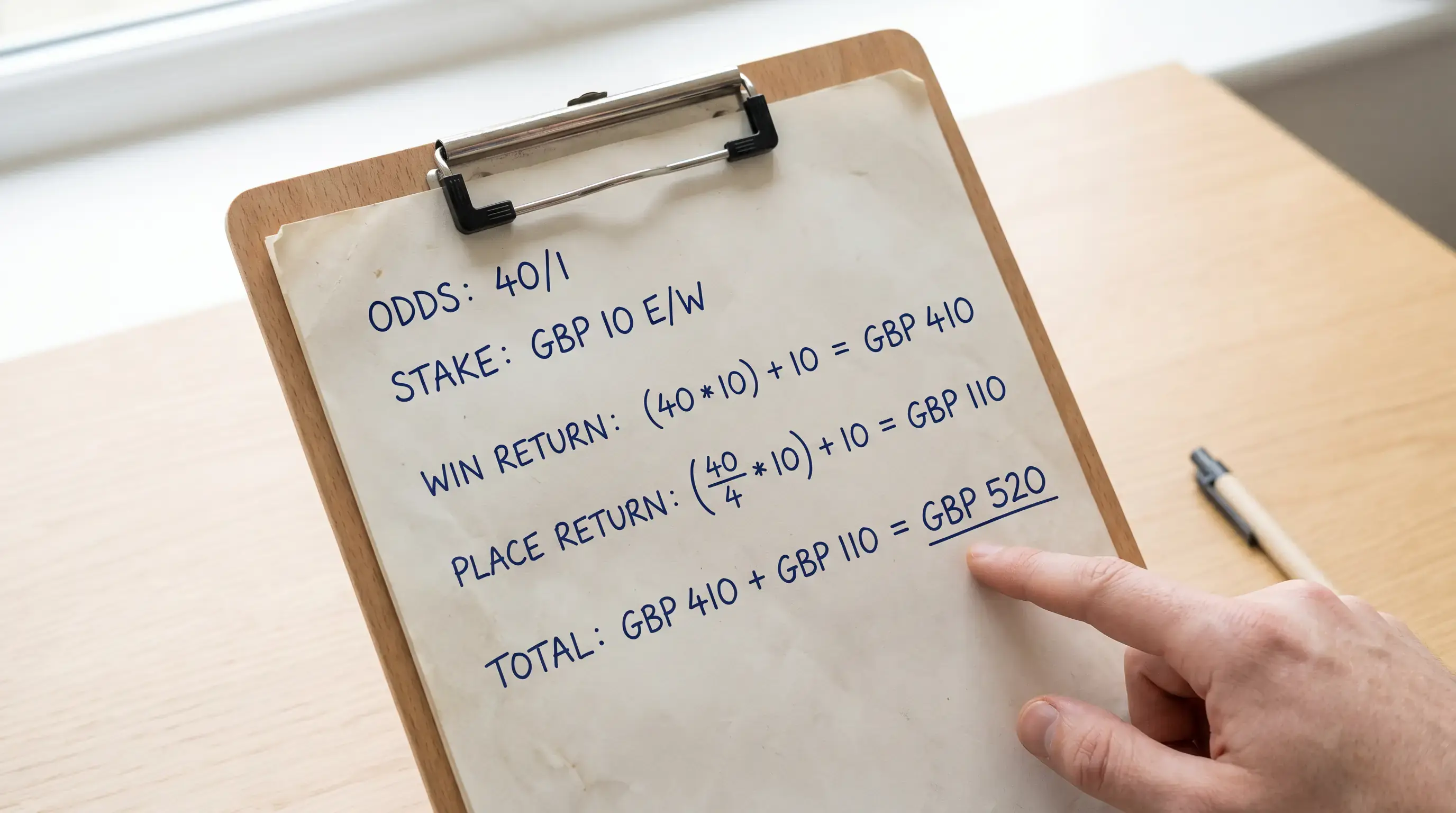
The example: you place £10 each-way (£20 total) on a player at 40/1, with terms of 1/5 odds, top 8.
Scenario one – the player wins the tournament. Your win bet pays: £10 x 40 = £400 profit, plus your £10 stake returned = £410. Your place bet also pays because the winner finishes in the top 8: £10 x 8 (which is 40 divided by 5) = £80 profit, plus your £10 place stake returned = £90. Total return: £410 + £90 = £500. Total profit: £500 – £20 (your original outlay) = £480.
Scenario two – the player finishes 5th (inside the top 8 but does not win). Your win bet loses: -£10. Your place bet pays: £10 x 8 = £80 profit, plus your £10 place stake = £90. Total return: £90. Total profit: £90 – £20 (total outlay) = £70. A fifth-place finish on a 40/1 each-way bet still returns 3.5 times your total outlay. That is the power of E/W on long-odds golf selections.
Scenario three – the player finishes 12th (outside the top 8). Both the win and place bets lose. Total return: £0. Total loss: £20. There is no middle ground in E/W – you either hit the place range or you lose everything. This is why understanding the probability of a top-8 finish, not just a win, is essential for evaluating whether an E/W bet carries genuine value.
One calculation that punters frequently forget: the breakeven point. On a 40/1 E/W bet at 1/5 top-8, your total outlay is £20. The place-only return is £90. That means you profit on any place finish, regardless of outright position. But what if the odds were shorter? At 10/1 with 1/5 top-8, the place-only return is £10 x 2 + £10 = £30. Profit: £10 on a £20 outlay. Still positive, but the margin is thin. At 4/1 with 1/5 top-8, the place return is £10 x 0.8 + £10 = £18. That is a loss of £2 on your total £20 outlay even with a place finish. E/W is not inherently profitable on short-priced players – the maths only works when the odds are long enough for the place fraction to compensate for the lost win stake.
Dead Heat in Each-Way Golf Bets: A Brief Overview
The first time a dead heat hit one of my each-way bets, I thought the bookmaker had made an error. My player finished tied for 7th, well inside the top-8 place terms, but my payout was roughly half what I expected. It was not an error. It was the dead-heat rule, and it catches more golf bettors off guard than any other settlement mechanism in the sport.
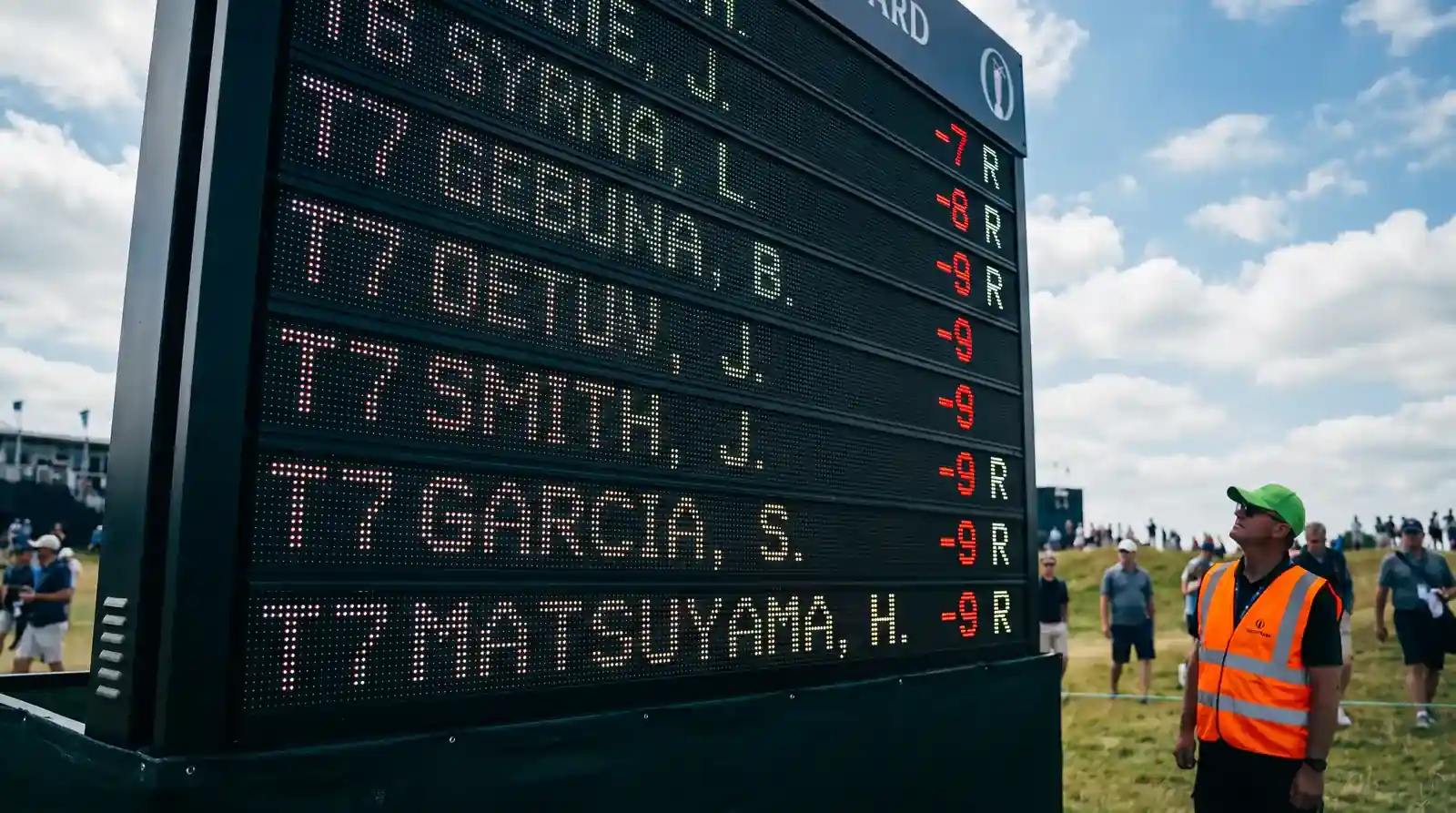
A dead heat occurs when two or more players tie for a position that straddles the place cutoff. If the terms pay top 8 and three players tie for 7th place, only two of those three positions (7th and 8th) fall within the paid range. The dead-heat rule splits the available places among the tied players and adjusts the payout proportionally. In this example, two places are available for three players, so the payout is calculated at two-thirds of the full place return.
The formula is: payout = full place return x (available places / number of tied players). In the scenario above, if the full place return would have been £90, the dead-heat-adjusted payout is £90 x (2/3) = £60. Your win bet is unaffected by the dead heat (it lost because the player did not win outright), so your total return is £60 against a £20 total outlay – still profitable, but meaningfully less than the £90 you would have received without the tie.
Dead heats are more common in golf than in most sports because of the scoring system. In a 72-hole event, ties for specific positions are frequent – fields routinely produce clusters of three, four, or even five players tied on the same score. Nearly half the UK adult population participates in some form of gambling, yet awareness of dead-heat rules remains remarkably low. For a full breakdown of dead-heat scenarios with detailed calculations, dead heat rules in golf betting covers every permutation you are likely to encounter.
E/W Strategy: When Each-Way Adds Value and When It Does Not
Grainne Hurst of the Betting and Gaming Council noted that the industry’s “record-breaking figures underline the industry’s ongoing commitment to raising standards.” Those record figures include a growing share of E/W handle on golf, and the bettors driving that growth are increasingly sophisticated about when E/W adds value and when it does not.
The core question is simple: does the each-way structure improve your expected value compared to an outright bet or a standalone place bet? The answer depends on three variables – the player’s outright odds, the place terms, and your assessment of the player’s finishing probability distribution.
E/W adds clear value when the outright odds are long (25/1 or above) and the place terms are generous (1/5 top-8 or better). At these prices, the place part of the bet carries a positive expected return even if you believe the player has zero chance of winning outright. Think of it this way: if you assess a 40/1 shot as having a 20% chance of a top-8 finish, the place part alone (8/1 at 1/5 terms) has a positive expected value at that probability. The win part is a free option on a low-probability event. The combined EV of the each-way bet exceeds either part individually.
E/W loses value when the outright odds are short (below 14/1) and the player is a strong win contender. At 10/1, the place part at 1/5 pays only 2/1. If you genuinely believe this player will win, the E/W structure dilutes your return by forcing half your total stake into a low-paying place bet. In those situations, an outright-only bet at full stake delivers a better return on your conviction. GGY for remote betting in the UK reached £2.4 billion in the most recent annual reporting period, and the bookmakers’ margins are thinnest at the top of the market – which means the value in E/W at short prices is further eroded by efficient pricing on favourites.
A middle-ground approach I have used successfully is the “split stake” strategy. Instead of £10 each-way (£20 total), I place £15 on the outright and £5 on a standalone top-5 or top-10 bet. This gives me a larger position on the outcome I believe is most likely (a win or near-win) and a smaller insurance stake on the place. It requires the bookmaker to offer standalone place markets, which most UK operators do for PGA Tour events, and it gives you more control over the ratio than the fixed 50/50 split that E/W imposes.

Each-Way Betting In-Play: How Terms Shift During a Tournament
Each-way terms in-play are a moving target, and the shift catches out punters who assume the pre-tournament terms apply throughout the event. They do not. As the tournament progresses and the field shrinks, bookmakers tighten their E/W offering to reflect the reduced field size and the increased probability of any remaining player finishing in the places.
The typical progression works like this. Pre-tournament, with a full field of 144-156 players, you see 1/5 odds, top 8. After the cut on Friday evening, the field drops to roughly 70 players. Some bookmakers reduce to 1/5 top 6 or 1/5 top 5. By Sunday afternoon, with only 20-30 players in realistic contention, the E/W terms might narrow further to 1/4 top 3 or disappear entirely on some platforms.
This narrowing has a direct strategic implication. If you plan to bet each-way in-play, the earlier you take your position, the better the terms. A player priced at 33/1 on Thursday morning with 1/5 top-8 terms offers far more generous E/W value than the same player at 33/1 on Saturday with 1/5 top-5. The odds might be identical, but the place terms have reduced your probability of a return.
I use the terms shift as a trigger for entry rather than a deterrent. When I see E/W terms tighten mid-tournament, I know the bookmaker is repricing risk – and sometimes the new terms create a gap where the outright odds have not fully adjusted. A player whose outright price drifts from 20/1 to 25/1 after round two (because he had a mediocre day) but whose E/W terms simultaneously narrow from top-8 to top-5 presents two separate assessments. The outright drift suggests reduced confidence. The terms narrowing suggests the bookmaker believes the remaining field is stronger. If my SG analysis says the player’s mediocre round was driven by putting variance rather than fundamental decline, I take the drifted outright price with full awareness that the E/W terms are less favourable – and adjust my stake accordingly.
The cash-out dimension adds another layer. Some bookmakers offer partial cash-out on E/W bets in-play, allowing you to lock in a portion of your place-part value while letting the win part ride. I rarely use this feature because the cash-out price typically includes a significant margin – the bookmaker is not offering you fair value to exit. But in specific scenarios, such as when your player is sitting 6th going into Sunday and the weather forecast threatens to blow up the leaderboard, a partial cash-out can protect against a scenario where your player drops from a comfortable place to just outside the terms.
Each-Way Golf Betting Questions
Do all UK bookmakers offer the same each-way terms on golf?
No. Terms vary significantly across operators. The standard for a full-field PGA Tour event is 1/5 odds for a top-8 finish, but some bookmakers offer 1/4 odds or extend to top-10 places, especially during major championships. Comparing terms across four or five bookmakers before placing an E/W bet is one of the simplest ways to improve your expected return.
Can you place each-way bets in-play on golf?
Yes, most UK-licensed bookmakers offer each-way markets during live golf rounds. However, the place terms typically narrow as the tournament progresses – from top-8 pre-tournament to top-5 or top-3 by the final round. The outright odds also adjust hole by hole, so the E/W value proposition changes continuously throughout the event.
What happens to my each-way bet if a golfer withdraws mid-tournament?
If a golfer withdraws before completing the tournament, the bet is typically settled as a loser for both the win and place parts – the player did not finish, so he cannot place. Some bookmakers apply Rule 4 deductions to the remaining market if the withdrawal affects odds. Always check the specific bookmaker’s golf withdrawal rules, as settlement can vary by operator.
Is each-way or outright better for long-odds golfers?
For players priced above 25/1, each-way is almost always better than outright because the place part carries positive expected value even if you assess the player’s win probability as very low. The place return on a 40/1 shot at 1/5 top-8 (paying 8/1 for a place) is generous enough to compensate for the lost win stake on place-only finishes. Below 14/1, outright is often preferable if you have genuine conviction.
Making Each-Way Work Harder for You
Each-way golf betting is not a passive market where you pick a name and hope for the best. The punters who extract consistent value from E/W understand the mechanics deeply enough to compare terms, calculate breakeven points, anticipate dead heats, and time their entries to capture the most generous place terms available. They know when E/W adds genuine value and when an outright or standalone place bet serves their assessment better.
The maths is straightforward once you have practised the calculations a few times. The strategy is a discipline that improves with every bet you analyse, whether it wins or loses. And the market opportunity is real – golf’s field size and scoring structure make E/W one of the most structurally advantageous bet types in any sport. Start by comparing terms across three bookmakers this week. Calculate the place-part EV on your next selection. The numbers will tell you whether to proceed, and if they do, you will proceed with confidence rather than hope.
Created by the ”Live Golf Betting” editorial team.