How Weather Affects Golf Betting Odds: The Variable Most Bettors Ignore
 Available in US

How Weather Affects Golf Betting Odds: The Variable Most Bettors Ignore
At the 2022 Open at St Andrews, I watched the afternoon wave get absolutely hammered by 30 mph winds while the morning starters had played in near calm. The scoring differential between waves was over three strokes on average. Anyone who had backed an afternoon player for first-round leader lost before the 10th tee. That day crystallised something I had suspected for years: weather is not a secondary factor in golf betting. It is the single variable most capable of reshuffling a leaderboard in 30 minutes flat.

Golf is an outdoor sport played across 18 holes over four to five hours per round. Every shot is exposed to the elements. No other major betting sport has the same level of weather dependency — a football match plays to completion in almost any rain, a tennis match moves indoors or gets covered. Golf just carries on, and the players who handle the conditions best often bear no resemblance to the pre-tournament favourites. Live betting has become the leading category on the global sports betting market, and in golf, weather is the primary driver of in-play volatility. In-play betting thrives on uncertainty, and nothing manufactures uncertainty faster than a weather front sweeping across a links course at 2pm.
Wind Speed and Direction: The Biggest Odds Mover in Golf
Wind is the most impactful weather variable in professional golf. Rain makes things uncomfortable. Cold affects feel and distance. But wind — sustained wind above 15 mph — fundamentally changes how the course plays, which clubs are required, and which players can cope.
The threshold I use is simple: below 12 mph, wind is a nuisance but not a game-changer. Between 12 and 20 mph, it becomes a significant scoring factor that benefits certain player profiles. Above 20 mph, it reshapes the tournament. At 25+ mph, you are in “survival golf” territory where par is a good score and the players who grew up on windy coastlines hold an outsized advantage.
Direction matters as much as speed. A hole that plays into a headwind adds 15-20 yards to the effective distance. A helping tailwind shortens it but makes club selection and stopping the ball on firm greens more difficult. Crosswinds demand shot-shaping — the ability to curve the ball into the wind or ride it with the wind — and players with a naturally low ball flight gain strokes in these conditions because their shots are less affected by wind.
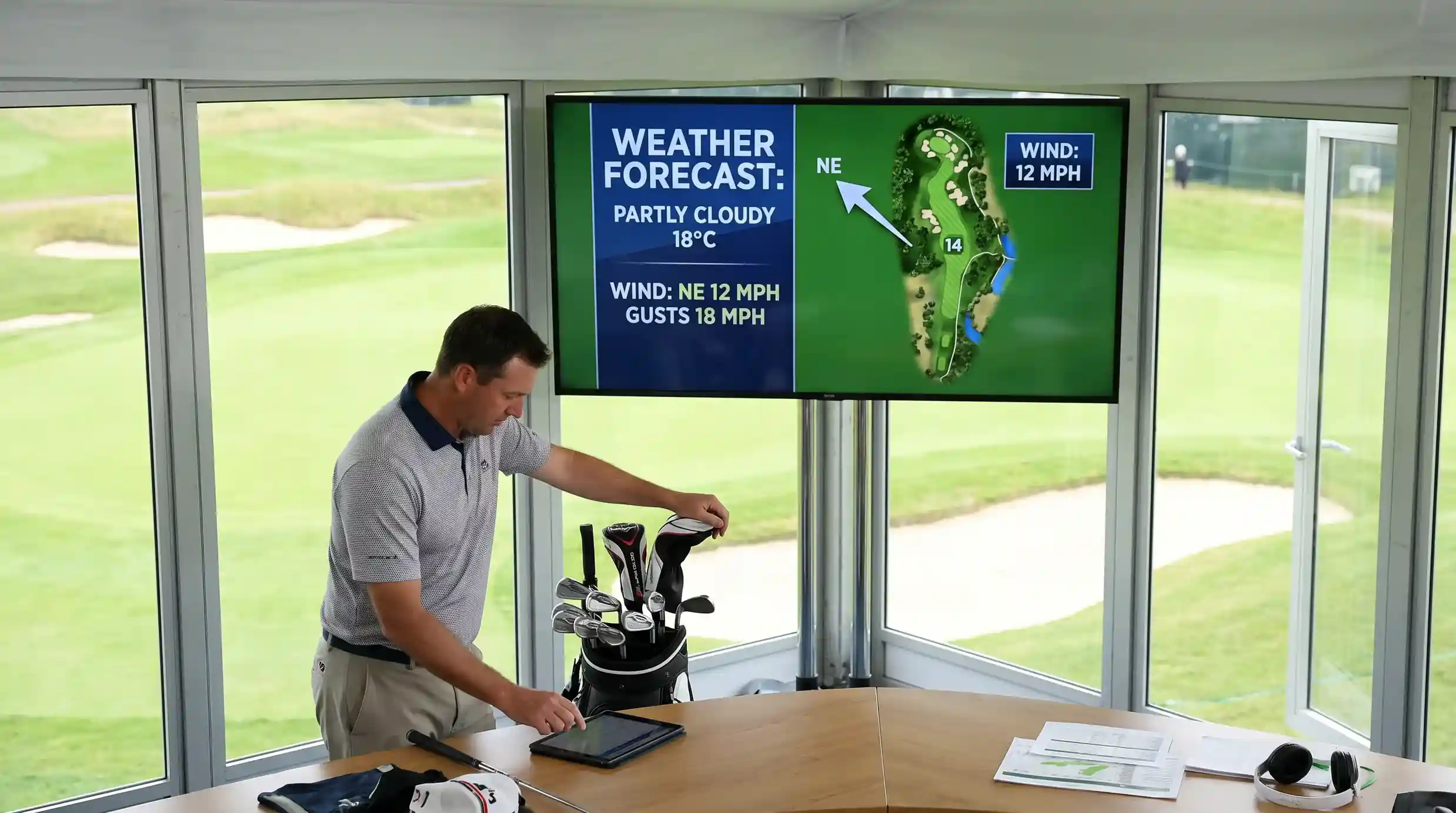
For betting, the key is how quickly the odds reflect changing wind conditions. Algorithms price based on forecast data, but forecasts have a resolution problem: they predict average conditions for a multi-hour window, not the specific gusts that hit during a player’s approach to a pivotal par-3. Scott Warfield, the PGA Tour’s VP of Gaming, has described the Betcast as an experience that integrates live data including weather overlays for both fans and bettors. That real-time weather information is exactly what sharpens in-play decisions. When I see wind speed climbing on a live tracker while odds have not yet adjusted, I know there is a narrow window to act. An effective in-play strategy builds weather monitoring into its core framework, not as an afterthought.
Rain Delays and Suspended Play
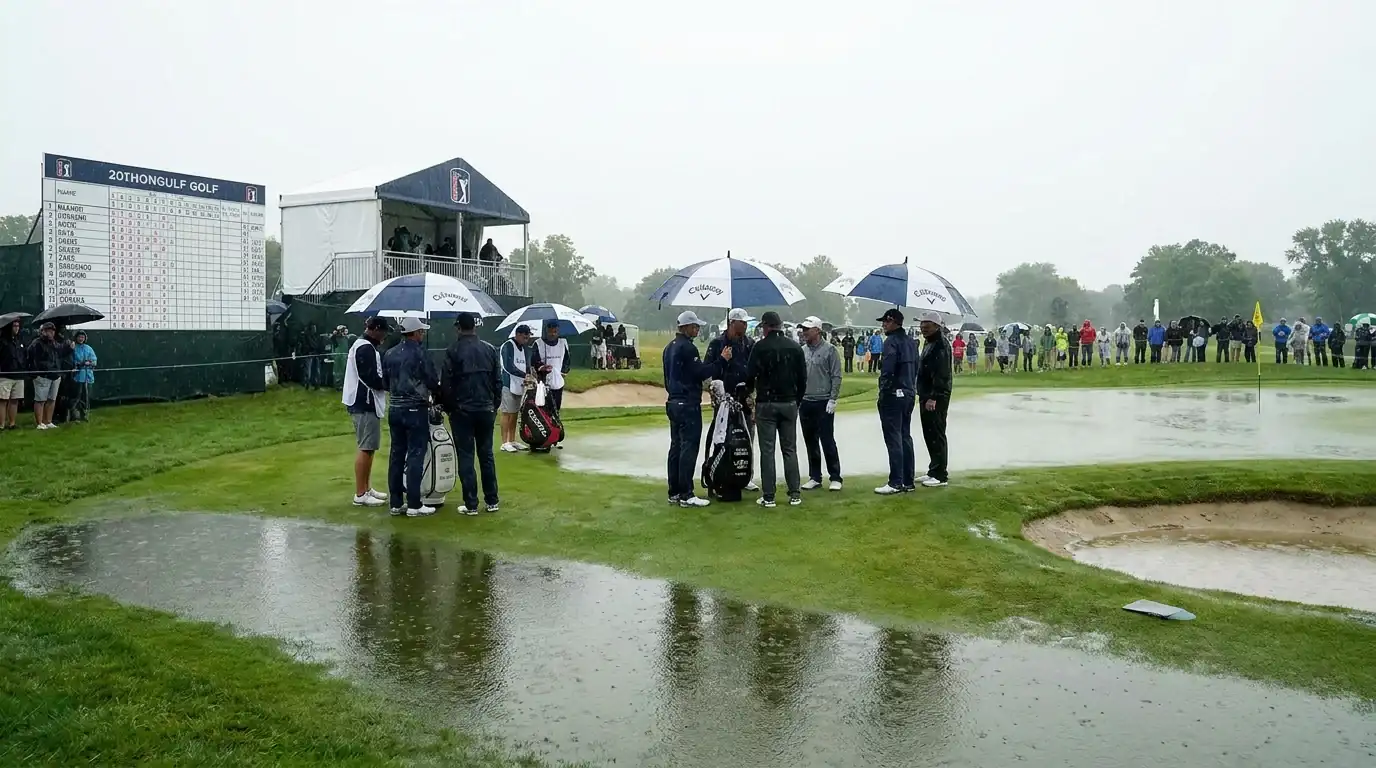
Rain delays are the most disruptive weather event for both players and bettors. When lightning or dangerous conditions force a suspension of play, everything stops — including, for most bookmakers, the in-play markets. Players return to the clubhouse, rhythms are broken, and the resumption of play can feel like a completely different round.
What happens to the course during a rain delay is often more important than the delay itself. Heavy rain softens fairways, lengthens the effective yardage, and makes greens more receptive. A course that was playing firm and fast before the delay might play soft and long after it. This helps certain players — those who carry the ball a long way rather than relying on run-out, and those whose approach game benefits from greens that hold. A player who was struggling to hold firm greens might suddenly find the conditions suit them better post-delay.
The Betcast expansion to 400+ hours of live coverage in 2026, spanning 12 PGA Tour tournaments, means more events will have broadcast-quality data available through delays and resumptions. For bettors, that means better visibility into how the course is playing after a restart — a genuine informational edge over pre-delay prices that have not yet been updated.
When markets reopen after a delay, there is often a repricing lag. Bookmakers adjust for the general impact of rain, but they cannot instantly recalibrate for every player-specific effect. A player with a high-ball-flight iron game who was overpriced on a firm course might suddenly represent value on a rain-softened track. That repricing gap is one of the most consistent edges I have found in live golf betting, and it repeats every time the weather changes materially mid-round.
AM/PM Wave Advantage and How to Spot It
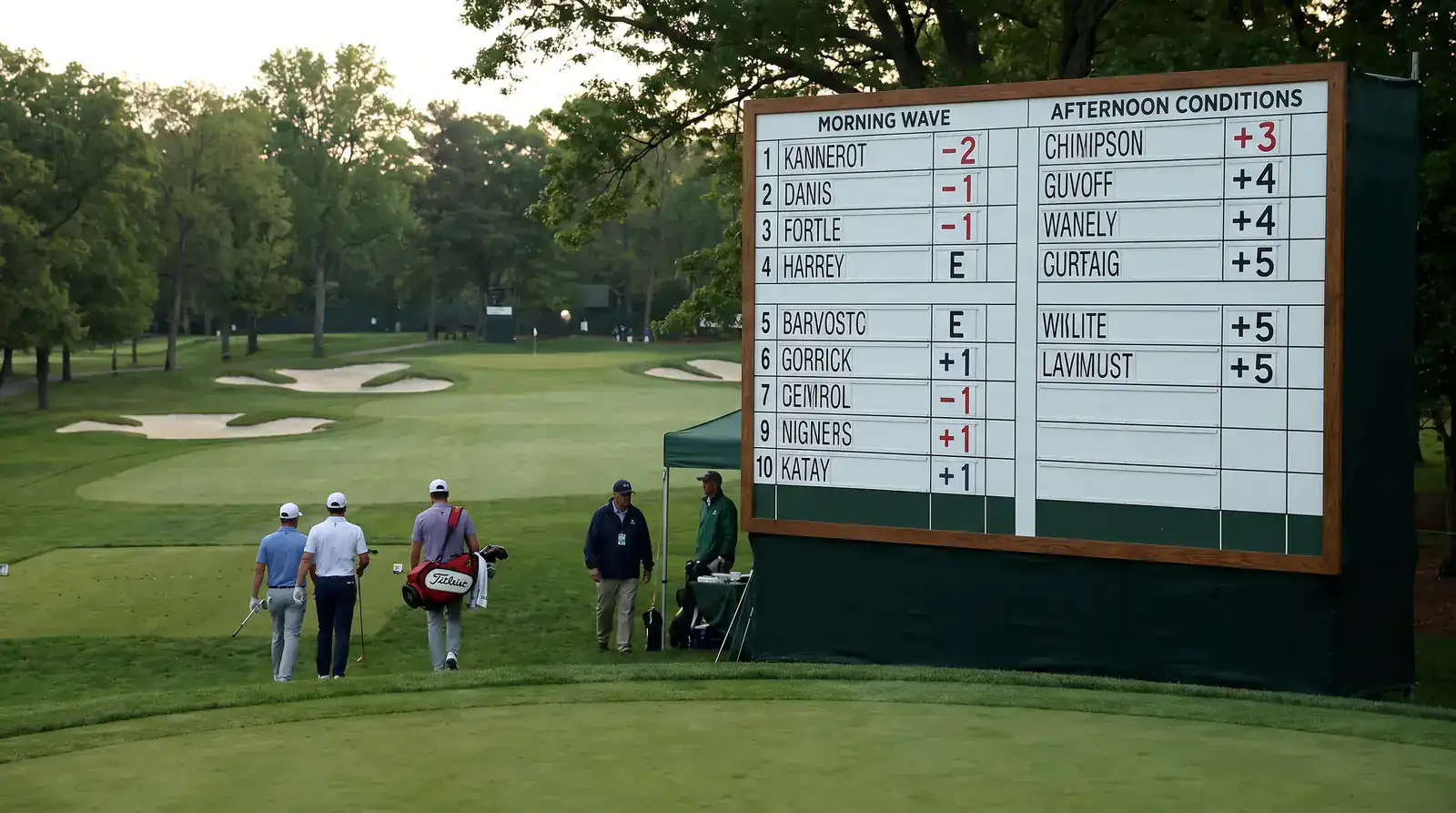
Wave splits are weather’s most predictable betting impact in golf, and they matter most in Rounds 1 and 2 when the full field plays in two waves. Half the players tee off between roughly 7am and 9am local time; the other half go out between 12pm and 2pm. The weather conditions across those two windows can differ enormously.
The classic pattern: calm, cool mornings with soft greens give way to windy, warm afternoons with firmer, faster putting surfaces. The morning wave scores better — sometimes by a full stroke on average. This creates a structural disadvantage for afternoon starters that the outright and first-round-leader markets must account for. Some bookmakers are slow to adjust: they price the FRL market based on form and ranking without fully weighting the wave assignment.
I track wave advantage in real time. Once the morning wave is mostly through their rounds, I can calculate the average scoring and compare it to expectations. If the morning starters averaged 3 under par in calm conditions and the forecast shows 20 mph winds arriving for the afternoon, I know the afternoon wave will score higher on average. That knowledge feeds directly into FRL bets (morning players become more likely leaders), outright market entries (afternoon players who started at 25/1 might drift to 40/1 through no fault of their own game), and two-ball markets (an afternoon pairing where one player handles wind better than the other).

The reverse pattern also occurs, though less commonly. If morning fog delays the start and soft, cool conditions greet the morning wave, but the afternoon clears to sunshine and wind, the dynamic flips. Or if rain hits specifically during the morning window and clears by afternoon, the PM wave might get the better deal. The key is checking the hourly forecast rather than the daily summary, because a “partly cloudy with winds of 15 mph” day might feature 8 mph at 8am and 22 mph at 3pm.
Weather as an Edge, Not an Excuse
Most golf bettors treat weather as background information — something to note but not to act on. That passivity is a gift to those of us who treat it as a primary input. Weather creates information asymmetries that the market is structurally slow to price, because algorithms rely on forecast averages while reality plays out in specific gusts and sudden showers. Every rain delay, every wind shift, every wave-split advantage is an opportunity for the bettor who is watching the conditions on the ground rather than the odds on the screen. The punter who checks the hourly wind forecast at 6am and adjusts their plan before the first ball is struck will consistently outperform the one who opens the betting app at lunchtime and backs the leaderboard leader.
Where can I check real-time weather conditions at a golf tournament?
Several free options are available. Weather apps like Windy and Weather Underground provide hourly forecasts by GPS coordinates, so you can pin the exact course location. The PGA Tour’s live coverage and Betcast both display on-screen wind and weather data during broadcasts. Social media accounts of on-course reporters often post real-time conditions including wind speed and direction. For The Open, the R&A typically provides weather updates on its official channels.
Do bookmakers adjust golf odds automatically when weather changes?
Partially. Bookmaker algorithms incorporate forecast data into their pricing models, but they adjust based on anticipated average conditions rather than real-time gusts. Manual trader intervention handles unusual situations like sudden storms or unexpected delays. The result is that odds tend to lag behind fast-changing weather, especially during transitional periods when conditions shift within a single round. That lag is where informed bettors can find value.
Written by the editors at Live Golf Betting.