Golf Betting Markets Explained: Every In-Play and Pre-Match Type
 Available in US

Table of Contents
- Golf Betting Markets Explained: From Outright to Shot-Level Wagers
- Outright Winner: The Flagship Golf Bet
- Each-Way: How Place Terms Shape Your Return
- Head-to-Head and Two-Ball Markets
- Top 5, Top 10 and Top 20 Finish Markets
- First-Round Leader
- Prop Bets and Tournament Specials
- Micro-Markets and Shot-Level Betting
- Picking the Right Market for Your Bet
- Golf Betting Markets: Common Questions
- Mapping the Right Market to Your Edge
Golf Betting Markets Explained: From Outright to Shot-Level Wagers
My first ever golf bet was an outright wager on a 66/1 shot at the 2014 Open Championship. I picked the player because I liked his swing. He missed the cut by six strokes. What I did not know then – and what took me years to properly grasp – is that golf offers more distinct betting markets than almost any other sport, and picking the right market matters as much as picking the right player.
Golf betting markets span everything from the traditional outright winner, a bet type as old as tournament golf itself, to shot-level micro-markets that did not exist two years ago. The sheer volume of betting opportunities comes down to the sport’s structure: four rounds, 18 holes per round, fields of 144 players, and a scoring system that produces meaningful data on every single shot. The PGA Tour’s handle growth of 20% in 2025 – a fourth consecutive year of double-digit increases – reflects both a growing audience and an expanding menu of markets that keeps experienced punters engaged week after week.
This guide walks through every market type available to UK punters, from the familiar to the cutting-edge. For each market, I cover how it works, how it behaves in-play, and when it makes sense to use it. Whether you have been betting on golf for a decade or are exploring beyond outright winners for the first time, understanding the full landscape of golf betting markets is the foundation for everything that follows.
Outright Winner: The Flagship Golf Bet
Ask any UK punter what a golf bet looks like and they will describe the outright winner market – a single wager on which player will lift the trophy. It is the most straightforward market in golf and the one that generates the most handle across UK bookmakers. It is also, paradoxically, one of the hardest markets to beat consistently.
The difficulty is structural. A typical PGA Tour field has 144 players, and even the world number one enters most events somewhere between 6/1 and 10/1. Compare that to football, where a heavy favourite might be priced at 4/9. In golf, the favourite loses roughly 85-90% of the time. That mathematical reality shapes everything about outright betting strategy: you are not looking for winners, you are looking for value at a price that compensates for the overwhelming likelihood of losing.
In-play outright markets are where things get interesting. Pre-tournament, the odds reflect a four-day horizon. Once play begins, the odds recalculate after every hole, every score change, every withdrawal. A player who birdies the first three holes will see his outright price compress rapidly. A player who makes double bogey on the opening hole might drift from 40/1 to 80/1 within minutes. The volatility is extreme compared to team sports, and that volatility is where experienced in-play bettors find their opportunities.

One thing I have learned the hard way: outright in-play bets should almost always be taken in the first two rounds rather than on Sunday. By the final round, the market is efficient – too many eyes, too much data, too little informational edge. Early rounds, when the field is still 144 and the market is spread thin, produce the best outright value.
Each-Way: How Place Terms Shape Your Return
If outright betting is the headline act, each-way is the backbone of UK golf betting. E/W is essentially two bets in one: a win bet and a place bet. You stake the same amount on each part, so a “£10 each-way” bet costs £20 total – £10 on the player to win and £10 on the player to finish in a specified number of places.
Place terms vary by bookmaker and field size. The standard offering for a full-field PGA Tour event is 1/5 of the odds for a top-8 finish, though some bookmakers offer 1/4 odds or extend to top-6 or top-10 places during major weeks. Those term variations have a significant impact on your expected return. A player at 50/1 with 1/5 top-8 terms gives you 10/1 on the place part. The same player at 50/1 with 1/4 top-6 terms gives you 12.5/1 on the place part but with a narrower target. Comparing terms across bookmakers before placing an E/W bet is not optional – it is the easiest value gain in golf betting, and the full breakdown of each-way terms and strategy deserves its own deep dive.
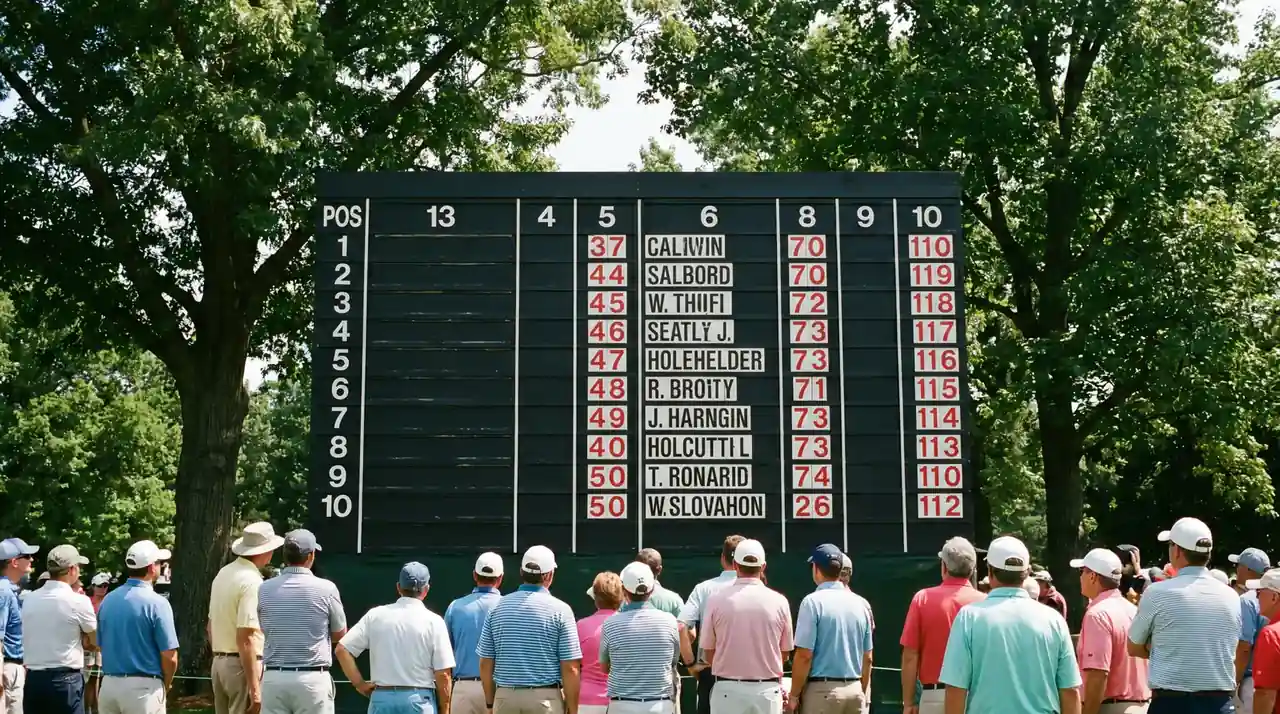
In-play E/W markets narrow as the tournament progresses. Early in round one, you might find top-8 place terms. By Sunday afternoon, some bookmakers reduce to top-5 or top-3, and the place fraction may tighten. This narrowing is worth tracking because a player who looks like strong E/W value on Thursday might offer far less favourable terms by Saturday.
The genius of E/W for golf is that it mitigates the harshest statistical reality of the sport – the overwhelming probability that any given player will not win. A top-8 finish is a far more achievable outcome than an outright victory in a 144-player field, and the place part of an E/W bet converts losing outright positions into returns far more often than most punters realise.
Head-to-Head and Two-Ball Markets
Two-ball betting was where I first started making consistent returns from in-play golf. The concept is simple: the bookmaker pairs two golfers who share the same tee time, and you back one to outscore the other over 18 holes. Ties are typically a push, meaning your stake is returned.
What makes two-ball markets appealing for in-play wagering is their reduced complexity. Instead of assessing 144 players, you are analysing two. The head-to-head dynamic removes field noise and focuses entirely on who plays better on that specific day. Tee-time draw is central to pricing – players in the same group face identical conditions, which eliminates the AM/PM wave advantage that distorts tournament-level markets.
Three-ball markets work the same way but with three players grouped together. The odds are longer because you are picking one from three rather than one from two, and ties become more common. I personally find three-ball less useful for in-play because the triangular dynamic introduces unpredictability that is harder to model.
Tournament-level head-to-head matchups also exist – two players paired against each other for the entire 72 holes regardless of groupings. These are priced pre-tournament and settle after the final round. They are excellent for in-play trading because the lead can change multiple times across four days, creating entry and exit points that do not exist in a single-round two-ball.

Top 5, Top 10 and Top 20 Finish Markets
Top-finish markets sit in the sweet spot between outright betting and each-way. You select a player to finish inside the top 5, top 10, or top 20, and the bet settles based purely on their final position. No place fractions, no dead-heat complications on the win part – just a clean positional threshold.
The pricing on top-finish markets reflects the probability more intuitively than outright odds. A player at 25/1 for the outright might be 3/1 for a top-5 finish and 6/4 for a top-10. Those shorter odds feel more grounded, and the strike rate is dramatically higher. Over a full PGA Tour season, a skilled top-10 bettor can maintain a positive yield more consistently than an outright bettor because the variance is lower and the market is less efficient at pricing positional probability than win probability.
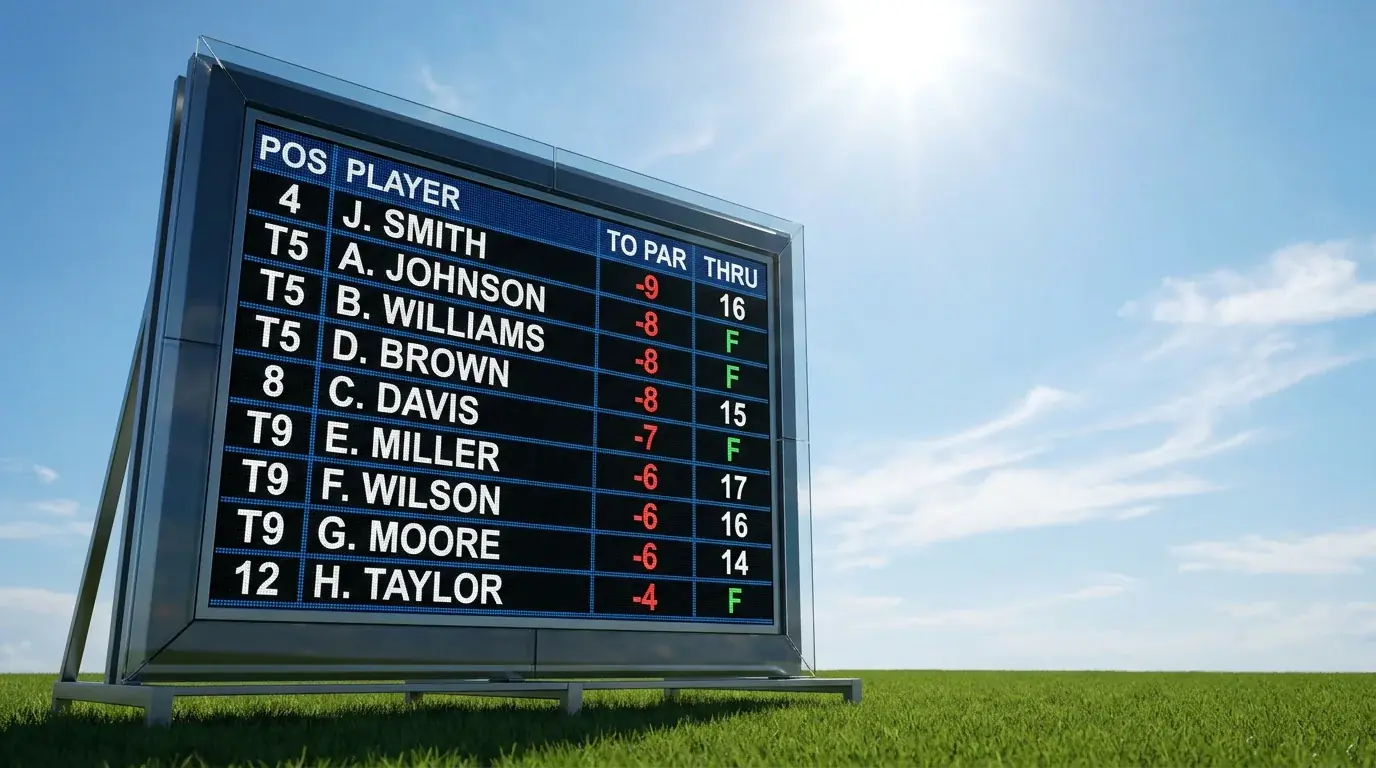
In-play, top-finish markets exhibit nonlinear volatility that creates sharp trading opportunities. A player sitting 12th after three rounds might be priced at 2/1 for a top-10 finish. One bogey on the first hole of round four can push him to 15th, and the price balloons to 4/1 – even though he still has 17 holes to recover. That nonlinearity, where small scoring changes near the threshold produce outsized price movements, is where experienced in-play punters find the most consistent value in golf.
The risk with top-finish markets is the Sunday leaderboard compression. In the final round, players bunched between 5th and 15th can swap positions multiple times per hole. A top-5 bet that looks safe at the 14th hole can be torpedoed by a bogey on 15 and two other players birdying 16. I manage this by taking top-finish positions earlier in the tournament – rounds one and two – when the market has not yet fully priced in a player’s trajectory.
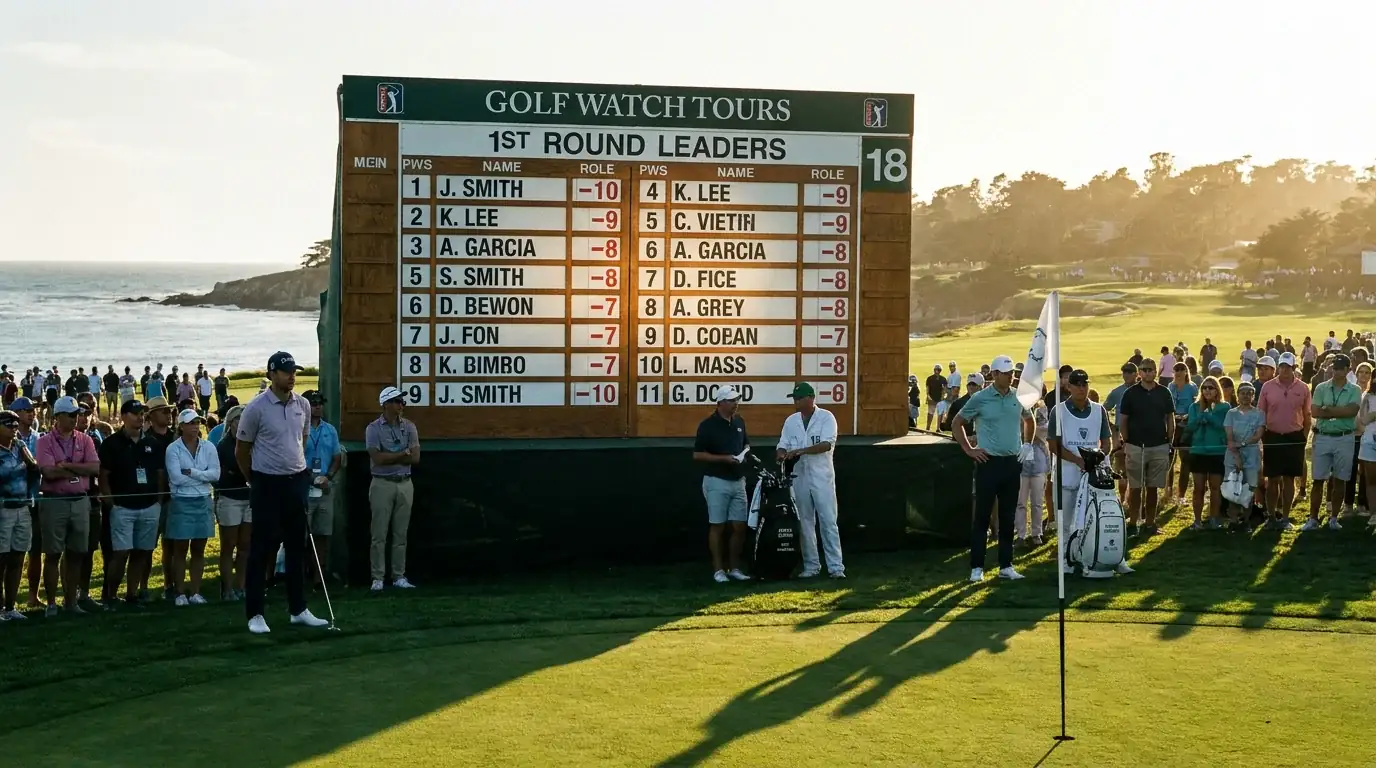
First-Round Leader
The first-round leader market is a single-day bet that settles after round one. You back a player to post the lowest score of the day. It is quick, contained, and – if you understand wave dynamics – one of the most exploitable markets in golf.
The AM/PM wave split is the key factor. In most tournaments, half the field tees off in the morning and half in the afternoon. Wind, temperature, and green firmness change between waves, and the scoring difference can be significant. If morning conditions are calm and greens are soft from overnight moisture, the morning wave holds a structural advantage. FRL prices typically do not adjust enough for this wave bias, especially at events where the split has been pronounced in previous years.
I approach FRL betting by cross-referencing two data points: a player’s scoring average in round one specifically (not his overall tournament scoring) and his wave assignment relative to the weather forecast. Some golfers are consistently strong starters – their round-one scoring average is measurably better than their overall average. Pairing that tendency with a favourable wave draw creates a genuine informational edge over the market.
FRL is not an in-play market in the traditional sense because it settles after one round, but you can trade positions during round one as live FRL odds adjust hole by hole. A player who birdies his first two holes will see his FRL price shorten dramatically, and if you backed him pre-round, you can lock in profit or let the position ride with a clear data-driven rationale.
Prop Bets and Tournament Specials
Scott Warfield of the PGA Tour described the product development team as exploring “all sorts of opportunities to integrate into the live feed, like single game parlays and new micro markets.” Proposition bets – or props – are the broadest expression of that expansion. They cover any outcome that is not directly tied to a player’s finishing position.
The most common golf props include total birdies in a round (over/under), whether a specific player will make an eagle, whether a hole-in-one will occur during the tournament, and make/miss cut bets. Seasonal props – like top nationality winner at a major, or which left-hander will finish highest – are also offered by most UK bookmakers during major championship weeks.
Sportradar’s expanded partnership with operators, bringing 3D shot tracking and data feeds from 39,000 official events, has fuelled a rapid increase in prop market availability. Five years ago, you might find three or four prop options for a regular PGA Tour event. Today, a major championship can offer 30 or more distinct prop markets across UK bookmakers.
The betting edge in props lies in their relative inefficiency. Bookmakers devote their sharpest traders to outright and top-finish markets, where the handle is highest. Prop markets receive less analytical attention, which means the pricing can be softer. I use course-specific birdie rates and player-level SG data to assess props like “total birdies over/under 3.5 in round two” – the same analytical tools that the bookmaker’s trader may not have applied with the same depth to a lower-handle market.
Micro-Markets and Shot-Level Betting
If props are the frontier, micro-markets are the new world beyond it. Shot-level betting – wagering on the outcome of a single swing – barely existed in golf two years ago. The PGA Tour’s Betcast expansion from 6 tournaments and 50 hours to 12 tournaments and over 400 hours of live coverage in 2026 is building the infrastructure for micro-markets to become a mainstream category.
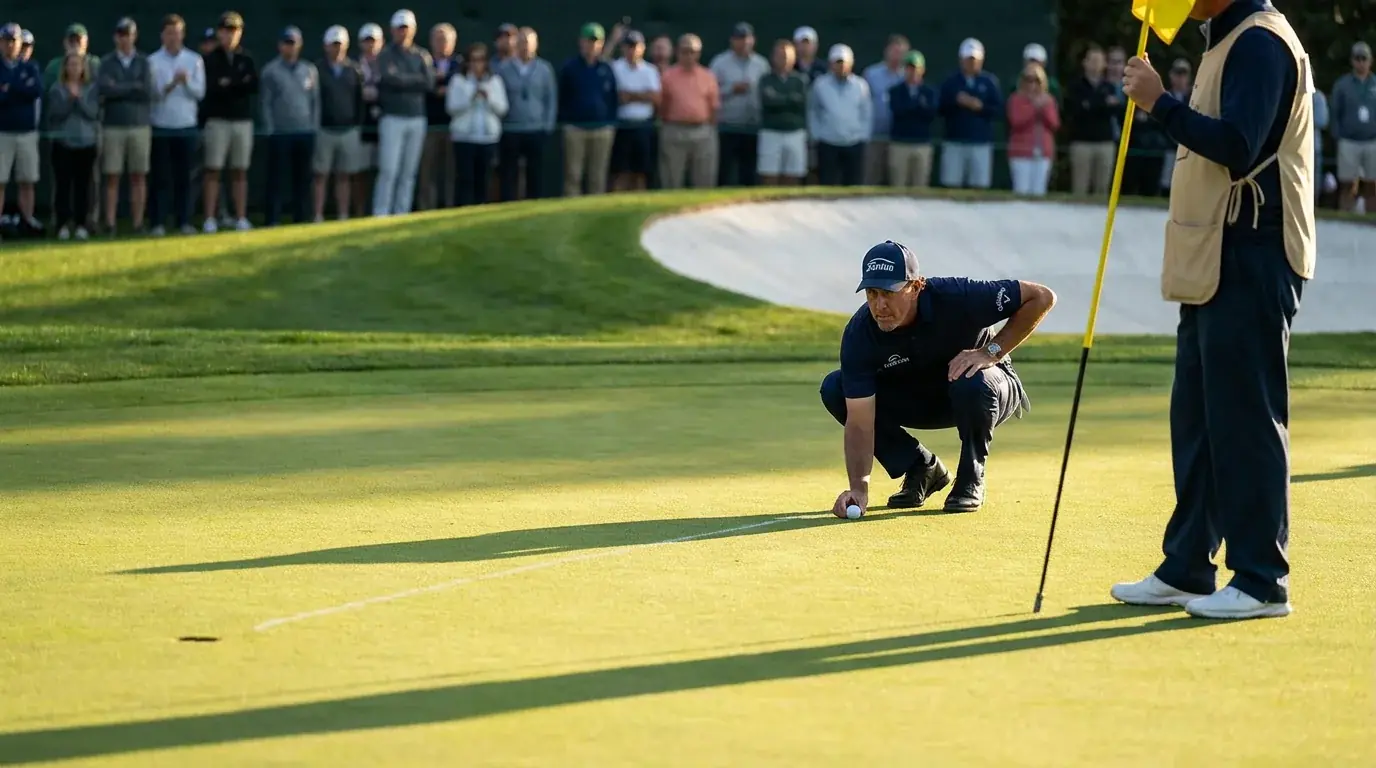
Micro-markets differ from hole-by-hole betting in granularity. Hole-by-hole markets settle on the outcome of an entire hole – birdie, par, bogey. Micro-markets settle on individual shots: will this drive land in the fairway, will this approach hit the green, will this putt from 15 feet go in. Each shot becomes a separate betting event, and a single hole can generate three or four distinct wagers.
The technology enabling this is Sportradar’s data pipeline, which combines ShotLink tracking data with 3D shot visualisation. When a player addresses a tee shot, the system can generate a fairway-hit probability based on the player’s driving accuracy, the hole’s fairway width, wind conditions, and the player’s historical performance on that specific hole. That probability is translated into a price, and the market opens for the 15-20 seconds before the shot is struck.
For UK punters, micro-market availability is still limited compared to the US. The Betcast integration is currently DraftKings-centric and US-focused, but the underlying data infrastructure is global. As UK operators build out their in-play golf product – a process accelerated by the growing handle – shot-level markets will become standard. The punters who understand the data behind these markets now will have a significant head start when they arrive in full.

Picking the Right Market for Your Bet
Knowing every market is not the same as knowing which market to use. Over the years, I have settled on a simple decision matrix that maps my objective to the right market, and it has eliminated the scattered approach that cost me money early on.
If my objective is value – finding mispriced odds relative to my assessment of probability – outright and top-5 markets are the richest hunting ground. The longer odds in these markets mean even small mispricings translate into meaningful expected value. If my objective is safety – a higher probability of return, even at lower odds – top-10 and top-20 markets offer strike rates that smooth out the variance across a season. If my objective is engagement – a bet that keeps me involved hole by hole – two-ball and FRL markets provide quick resolution and a focused analytical exercise.
The time horizon matters equally. For a single-round trade, two-ball and FRL markets resolve within four to five hours and allow you to recycle capital into the next round. For a tournament-length position, outright and top-finish markets benefit from the compounding effect of four rounds of data, where your pre-tournament analysis has the most time to play out. In-play betting became the leading category globally in 2024 by volume, and the golfers who engage with the widest range of markets – matching their analytical edge to the right instrument – consistently outperform those who default to outright bets for every event.
One principle I follow without exception: never bet a market I do not fully understand. If I am unsure how a dead heat would settle on a top-5 market, I skip it. If I do not know whether a three-ball pays on ties, I walk away. The golf betting landscape is wide enough that there is always a market I do understand where I can deploy my analysis with confidence.
Golf Betting Markets: Common Questions
Which golf betting market offers the best value for in-play wagers?
Top-finish markets – particularly top 5 and top 10 – tend to offer the most consistent in-play value because the nonlinear price movements near positional thresholds create frequent mispricings. Outright markets offer larger potential returns but require higher variance tolerance. Two-ball markets are efficient for short-term, single-round value.
Can you combine different golf markets in an accumulator?
Most UK bookmakers allow golf accumulators across different tournaments or different market types within the same event. However, combining markets within the same tournament for the same player is usually restricted. Check the specific bookmaker’s accumulator rules, as they vary by operator and market type.
What is the difference between a two-ball and a three-ball bet?
A two-ball pairs two golfers in the same tee-time group, and you pick which one scores lower over 18 holes. A three-ball does the same with three players. Two-ball is simpler to analyse and typically offers shorter odds, while three-ball gives longer odds but introduces a third variable that adds unpredictability.
Are micro-markets available at UK bookmakers yet?
Micro-markets for golf are gradually becoming available through UK-licensed platforms, though coverage is still narrower than in the US market. The PGA Tour Betcast expansion to 400-plus hours in 2026 is accelerating the data infrastructure, and UK operators are expected to expand shot-level and hole-level markets as the technology matures.
Mapping the Right Market to Your Edge
Golf’s market landscape has expanded faster than any other sport in the UK betting ecosystem, and that expansion shows no sign of slowing. From the familiar territory of outright and each-way to the emerging frontier of shot-level micro-markets, every market type rewards a different analytical skill set and suits a different betting objective.
The punters who thrive are not the ones who bet every market – they are the ones who understand each market deeply enough to recognise which one fits their edge on a given week, at a given course, for a given player. Start with the markets you know best, build your understanding outward, and never deploy capital in a market whose mechanics you cannot explain to a friend over a pint. The market will always be there next week. Your bankroll might not be, if you rush into unfamiliar territory without doing the homework first.
Prepared by the Live Golf Betting editorial staff.