Finding Value in Live Golf Bets: How to Spot Mispriced In-Play Odds
 Available in US
Finding Value in Live Golf Bets: When the Odds Are Wrong
The bet I remember most clearly from 2024 was not a winner. It was a top-10 back on a player whose outright odds had drifted from 28/1 to 80/1 after a poor opening nine holes — three bogeys in five holes, including a double on a par-3. His in-play top-10 price had ballooned to 12/1. I looked at the shot data: two of the bogeys came from lip-outs inside four feet, and the double involved a plugged lie in a greenside bunker on a hole where the pin was tucked behind the sand. Bad luck, not bad play. I backed the top-10 at 12/1. He finished ninth. That is what value looks like in live golf — the odds reflecting what happened rather than what is likely to happen next.
Value in betting is a simple concept with a difficult execution: you bet when the odds imply a lower probability than your own assessment. In pre-match markets across major sports, finding value is hard because the pricing is sharp and the information is widely available. In-play golf is different. PGA Tour betting handle has grown by 20% in 2025 — the fourth consecutive year of double-digit growth — and the market is deeper than ever, but it remains structurally less efficient than in-play football or tennis. The field is large, the information flow is fragmented, and emotional overreactions happen on virtually every leaderboard.
Expected Value in Golf Betting: A Practical Calculation
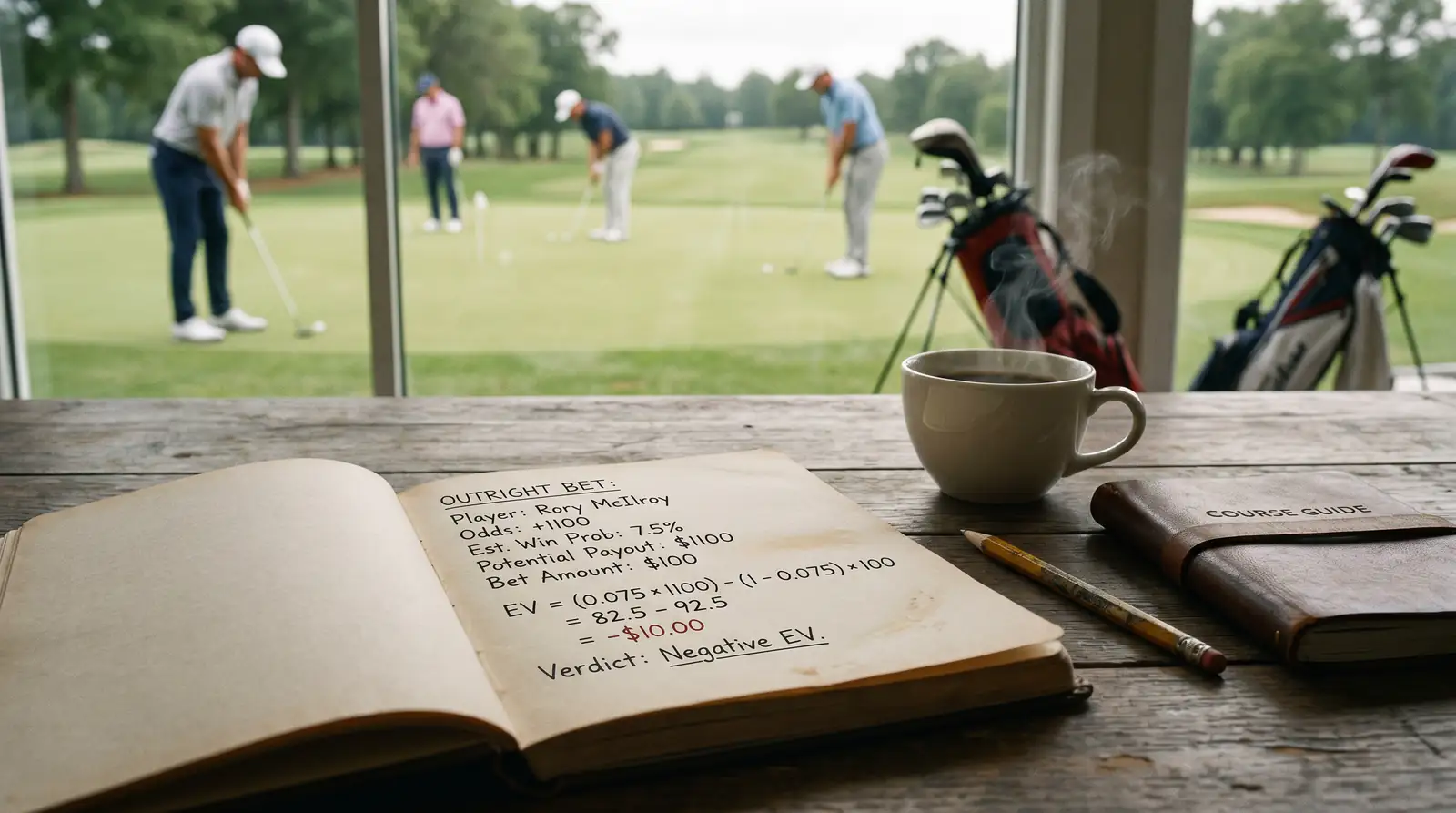
Expected value — EV — is the mathematical foundation of every profitable betting strategy. The formula is straightforward: EV equals the probability of winning multiplied by the profit if you win, minus the probability of losing multiplied by the stake lost. If EV is positive, the bet is theoretically profitable over time. If negative, you are paying more than the outcome is worth.
A worked example makes it concrete. Suppose a player is offered at 14/1 to win a tournament outright. You estimate his true probability of winning at 8% — higher than the 6.7% implied by 14/1 odds. The EV calculation: (0.08 × £14) minus (0.92 × £1) = £1.12 minus £0.92 = +£0.20 per £1 staked. That is a positive EV bet. Over hundreds of similar bets, you would expect to profit roughly 20p per pound wagered.
The challenge specific to golf is that even positive EV bets lose far more often than they win. An 8% win probability means the player fails to win 92 times out of 100. You can place 20 correct positive-EV outright bets in a row and lose all 20. The edge only materialises over a large sample, and most punters abandon the approach long before the sample is large enough to reflect the true probability. That is why bankroll management and emotional discipline are not optional supplements to a value strategy — they are prerequisites.
In-play EV is harder to calculate precisely because the probabilities shift continuously. But the principle holds: if you believe a player’s live probability of finishing top 10 is 30% and the market implies 20%, the bet has positive EV regardless of whether you can calculate it to two decimal places. Directional confidence — knowing you are on the right side of the probability — is sufficient for practical decision-making.
Where In-Play Golf Markets Get It Wrong
I have tracked in-play golf mispricing for three years, and the same patterns recur with remarkable consistency. The market is not random in its errors — it overreacts in specific, predictable ways.
Post-bogey overreaction is the most common. When a contender makes a bogey or double bogey, his odds drift immediately — often by more than the scoring change warrants. The market treats every dropped shot as new evidence about the player’s likely finishing position, but a single bogey on a difficult hole tells you very little about what happens over the remaining 50 or 60 holes of a tournament. If the bogey came from bad luck — a bad bounce, a lip-out, a gust of wind at the wrong moment — the drift represents a mispricing that reverts more often than not.
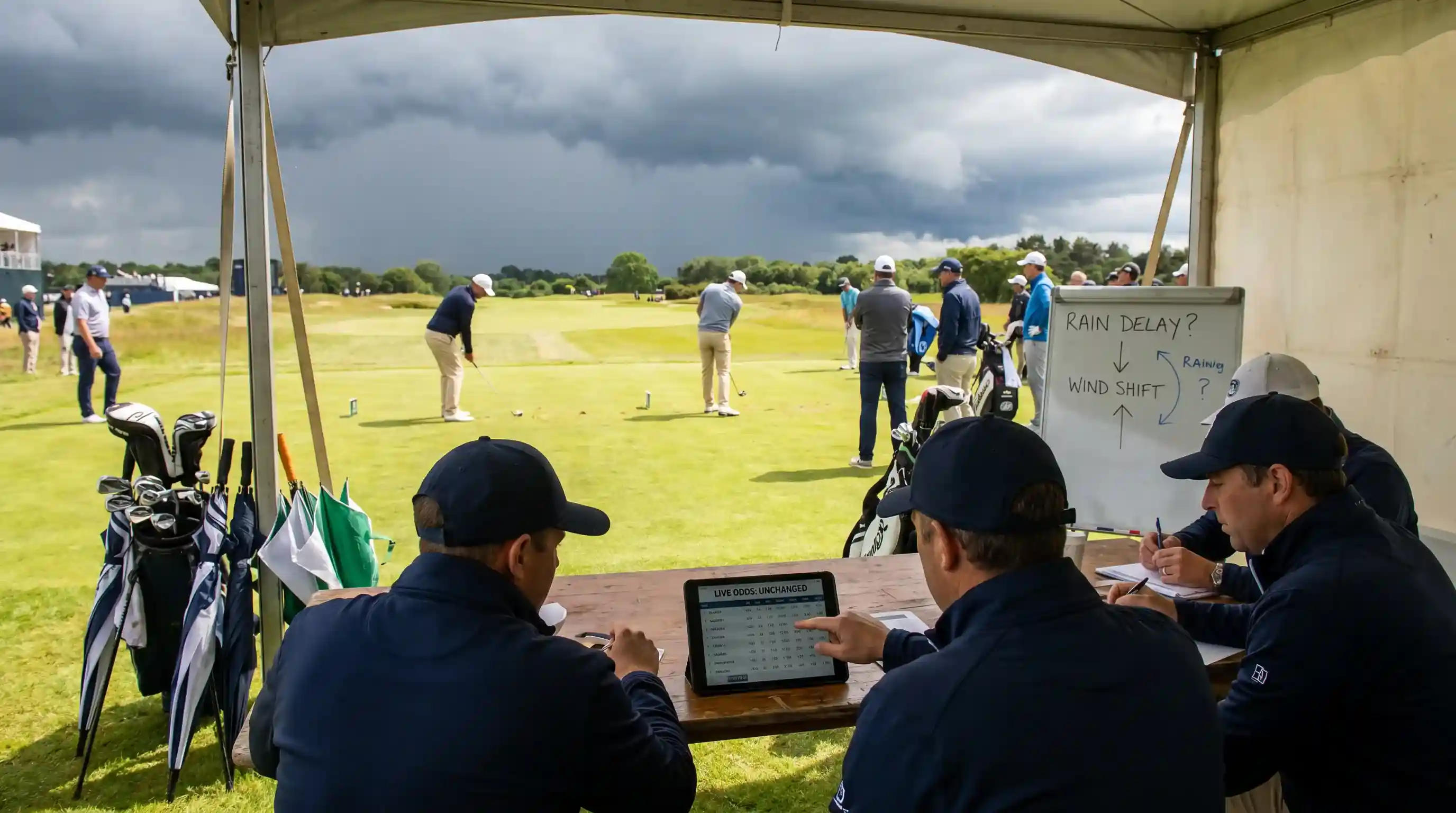
Weather underreaction is subtler. When conditions change mid-round — wind picks up, rain arrives, temperature drops — the market adjusts the leaders’ odds but often underweights the impact on the rest of the field. A player five shots off the lead who is about to play the easier stretch of the course in deteriorating conditions for those behind him may see his effective probability improve without his odds reflecting it. This is especially prevalent at links venues where wave splits create asymmetric conditions.
Scott Warfield, Vice President of Gaming at the PGA Tour, described the product development team as “nimble” and focused on “all sorts of opportunities to integrate into the live feed, like single game parlays and new micro markets.” That nimbleness means the market structure is still evolving — new market types are being introduced regularly, and whenever a new market launches, the pricing tends to be less efficient in its early iterations. Early-adopter bettors who understand the underlying probabilities can exploit soft opening lines before the market matures.

Field-size dilution is a structural inefficiency unique to golf. With 156 players in a typical full-field event, bookmakers cannot model every player with equal depth. The top 30 or 40 names receive detailed attention; the rest are priced using heuristic shortcuts — world ranking, recent results, generic course-type adjustments. If you have done deeper research on a player outside the top 40 in the field, your informational edge is largest precisely where the bookmaker’s model is thinnest.
Closing Line Value: Measuring Your Betting Skill
If you asked me for a single metric to assess whether a golf bettor is genuinely skilled or merely lucky, I would point to closing line value. It is the most reliable indicator of long-term profitability, and it is straightforward to track.
The closing line is the final price available on a market before it closes — in golf, this might be the last pre-tournament outright price before round one begins, or the last in-play price before a specific market suspends. If you consistently place bets at prices that are longer than the closing line, you are capturing value. If you back a player at 20/1 and his closing price is 16/1, you got a better deal than the market ultimately settled on — and over time, that edge translates into profit.

More than a quarter of all UK online gamblers have placed in-play bets, with the highest participation among 25-to-34-year-olds. Within that growing population, the punters who track closing line value separate themselves from those who do not. CLV is not a guarantee of profit on any individual bet, but across hundreds of bets it is the strongest predictor of whether your process is sound.
Tracking it is simple. Record the odds at which you placed each bet and the closing odds for the same market. Calculate the percentage difference. If your bets are consistently placed at odds 5-10% above the closing line, your process is working. If they are consistently below, you are systematically taking worse prices than the market offers — and no staking system will overcome that deficit. I review my CLV monthly as part of a broader betting audit, and it has been the single most useful diagnostic tool for identifying periods where my analysis was sharp versus periods where I was betting on emotion or habit.
Frequently Asked Questions
How do I calculate expected value on a golf in-play bet?
Multiply your estimated probability of the bet winning by the potential profit, then subtract the probability of losing multiplied by your stake. If the result is positive, the bet has positive expected value. In-play, precise probability estimates are difficult, but directional confidence — knowing you are on the right side — is sufficient for practical decision-making.
What is closing line value and why does it matter for golf bettors?
Closing line value measures whether you consistently place bets at better odds than the final market price. If you back a player at 20/1 and the closing price is 16/1, you captured value. Over hundreds of bets, consistently beating the closing line is the strongest indicator of long-term profitability in golf betting.
Value Is a Process, Not a Pick
Finding value in live golf bets is not about identifying a single “best bet” each week. It is about building a process — tracking EV, monitoring closing lines, cataloguing the specific patterns where in-play markets misprice — and executing that process with discipline over months and years. The edges in golf are real but small, and they only compound if your approach is consistent. I have been refining mine for over a decade, and the single most important lesson is that the market’s mistakes are not random. They follow patterns. Learn the patterns, and the odds work in your favour more often than against you.
Created by the ”Live Golf Betting” editorial team.