Golf Betting Bankroll Management: Why Golf Demands a Different Approach
 Available in US

Golf Betting Bankroll Management: Why Golf Demands a Different Approach
Three years into my golf betting career, I had a month where I hit two outright winners and a handful of top-10 finishes. The next three months, I lost it all back and then some. The wins were not the problem — the lack of a bankroll management system was. I was staking the same amount on a 100/1 outright as on a 4/5 two-ball, treating every bet as equal when the variance profiles were wildly different. Golf betting bankroll management is not a nice-to-have. It is the structure that keeps you solvent across a 40-week season.

Golf is the highest-variance major sport for betting purposes. Fields of 144 players mean even the world’s best have a win probability of roughly 5-10% at any given event. Long odds are the norm, not the exception. A punter who bets exclusively on outright winners might go eight, ten, twelve weeks without a winner even when making sharp selections. House of Lords committee findings showed that 60% of the gambling industry’s profits come from just 5% of customers who are problem gamblers or at risk — and undisciplined staking is one of the pathways that turns recreational betting into something more damaging. Bankroll management is your protection against variance consuming your bank and your enjoyment.
Unit Sizing for Golf Markets
Unit-based staking is the foundation. A unit is a fixed percentage of your total betting bank, and every bet you place is denominated in units rather than pounds. This approach automatically scales your stakes: as your bank grows, your bets grow proportionally; as your bank shrinks, your bets decrease, protecting the remaining capital.
For pre-tournament golf bets — outright winners, ante-post each-way, make-the-cut — I use 1-2% of my bank per bet. On a GBP 1,000 bank, that is GBP 10-20 per bet. The lower end (1%) applies to high-odds selections at 50/1 or longer, where the probability of winning any individual bet is small. The higher end (2%) applies to shorter-priced selections like top-10 finishes or two-ball bets where the probability is higher and the odds are shorter.

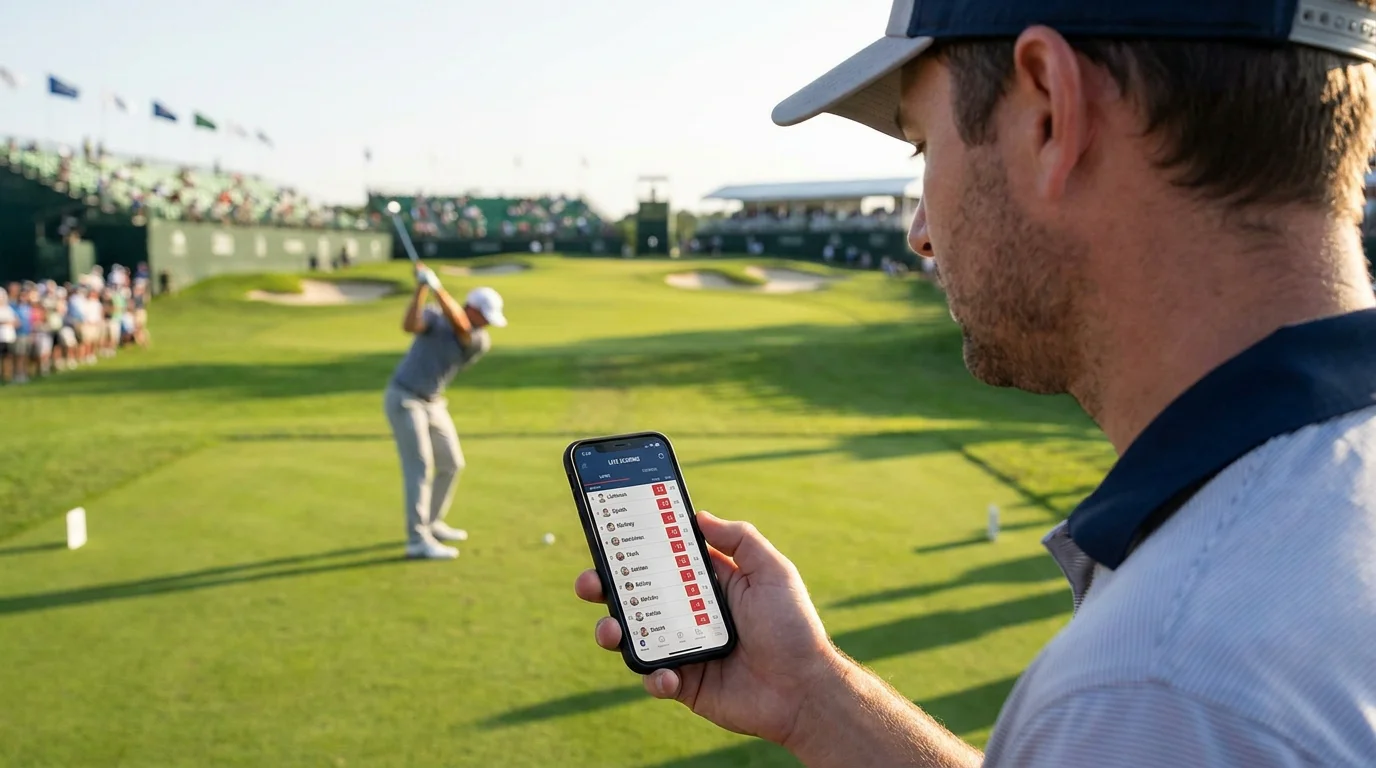
For in-play bets, I reduce unit size further — typically 0.5-1% of bank per bet. In-play markets are more volatile, the decision-making window is compressed, and the temptation to stack multiple bets within the same round is higher. A GBP 5-10 in-play bet from a GBP 1,000 bank might feel small when you are watching a player charge up the leaderboard, but it keeps you in control across a full day of 18 holes where six or seven betting opportunities might arise.
The logic behind smaller in-play units is straightforward: you place more in-play bets per tournament than pre-tournament bets. If you back three players ante-post at 2% each (6% total exposure pre-tournament) and then place eight in-play bets at 1% each (8% total in-play exposure), your overall tournament exposure is 14% of your bank. That is aggressive but manageable. If you staked 2% on each of those eight in-play bets, you would be at 22% — far too high for a single event in a 40-week season.
Conviction-based adjustments are tempting but dangerous. The moment you start telling yourself “this one is a 3-unit play” because you feel strongly about a selection, you have abandoned the discipline that unit sizing provides. My rule is rigid: every pre-tournament bet is 1 or 2 units, every in-play bet is 0.5 or 1 unit, and I never deviate. The moments when I feel most confident are often the moments when emotion, not analysis, is driving the conviction.

Maximum Exposure Per Tournament
Unit sizing controls individual bet risk. Exposure limits control aggregate risk across an entire event. Without both, you can find yourself with ten 1-unit bets on the same tournament, all of which depend on similar leaderboard outcomes — and if the leaderboard goes against you, you lose ten units in a single week.
I cap my total exposure per tournament at 5% of my bank. On a GBP 1,000 bank, that is GBP 50 across all bets — pre-tournament and in-play combined — for one event. This limit forces selectivity. I cannot bet on everything that catches my eye; I must choose the three, four, or five best opportunities and let the rest pass. The UKGC estimates that approximately 1.4 million UK residents experience gambling-related harm, and overexposure on single events — chasing loss or stacking impulsive bets during an exciting final round — is one of the behaviours that accelerates problems.
Within that 5% cap, I split roughly 40% to pre-tournament bets and 60% to in-play. The in-play allocation is larger because the informational advantage in-play is greater — you are betting with knowledge of current conditions, scores, and player performance rather than projections. That advantage justifies the higher proportion, provided each individual in-play bet remains small.

Planning Your Bank Across a Golf Season
The PGA Tour runs 45+ events per year. The DP World Tour adds another 35-40. Sprinkle in LIV Golf, the four majors, and the Ryder Cup, and you have a calendar that spans January to November with barely a week off. If you bet on every event at maximum exposure, you will cycle through your entire bank multiple times over the season. The question is not whether you can afford to bet every week but whether you should.
I divide the season into three tiers. Tier 1 events are the four majors and three or four other tournaments where my preparation, course knowledge, and data confidence are highest. These get the full 5% exposure allocation. Tier 2 events are regular tour stops where I have a decent view but less conviction — perhaps 3% exposure. Tier 3 events are weeks where I either skip entirely or place a single small bet as a watching brief.
Majors demand special treatment not because they are more important to the golf world but because they offer the deepest in-play markets, the best data, and the most comprehensive broadcast coverage. Betting 5% on the Masters and 5% on a mid-season event with thin markets and minimal broadcast access is not equivalent risk — the informational advantage at the Masters justifies the allocation. Responsible betting practices start with recognising that not every week deserves the same financial commitment.

End-of-season review is essential. After November, I calculate the season’s total P&L, review my strike rate by market type, and assess whether my unit sizing was appropriate. If I find that in-play bets consistently outperformed pre-tournament bets, I might shift the allocation toward a higher in-play proportion next season. The bank should grow — or at least not shrink — across a full season if the analysis is sound and the discipline holds. If the bank has declined, the first diagnostic is not “were my selections wrong?” but “was my staking appropriate?”
Discipline Is the Only Edge That Compounds
Every analytical edge in golf betting — course form, strokes gained, weather reads, in-play timing — is useless without the staking discipline to survive the inevitable losing stretches. I have watched sharp bettors blow up because they sized one bad week too heavily. I have watched mediocre analysts survive for years because their bankroll management was airtight. The edge compounds over time only if the bank survives long enough to collect it. Unit sizing, exposure limits, and seasonal planning are not exciting topics. They are the boring foundation that keeps the exciting parts possible.
How much of my bankroll should I risk on a single live golf bet?
A prudent range for a single in-play golf bet is 0.5% to 1% of your total betting bank. For a GBP 1,000 bank, that means GBP 5 to GBP 10 per in-play bet. The lower end applies to volatile markets like outright in-play entries; the higher end suits lower-variance markets like two-ball or top-finish bets. The key is consistency — the same unit size for every in-play bet, regardless of how confident you feel about a specific selection.
Should I use a separate bank for in-play golf bets?
Some bettors maintain a separate in-play bank to prevent live betting from consuming the pre-tournament allocation. This is a useful psychological tool if you find yourself overspending in-play during exciting rounds. A common split is 40% of your total golf bank for pre-tournament bets and 60% for in-play, with the in-play portion further divided by event. Whether you physically separate the funds or track them on a spreadsheet, the discipline of ring-fencing in-play capital helps control exposure.
Written by the editors at Live Golf Betting.