
Strokes Gained for Golf Betting: The Metric That Changes Everything
 Available in US
Strokes Gained for Golf Betting: The Metric That Changes Everything
I spent my first five years betting on golf using nothing more than world ranking and recent finishes. My results were mediocre. Then I started using strokes gained data, and within two seasons my strike rate on outright and top-finish bets improved measurably. Strokes gained is the single most important analytical tool in professional golf, yet almost no betting guide mentions it beyond a passing reference. That gap between what smart bettors use and what most guides recommend is where your edge lives.

Strokes gained, in one sentence, measures how many shots a player saves (or loses) compared to the field average on every type of shot. It was developed by professor Mark Broadie at Columbia University and adopted by the PGA Tour as its primary statistical framework. The concept is elegant: instead of counting raw numbers — fairways hit, greens in regulation, putts per round — strokes gained accounts for the difficulty of each shot based on its starting position and calculates how much better or worse a player performed relative to the average.
The Four Strokes Gained Categories Explained
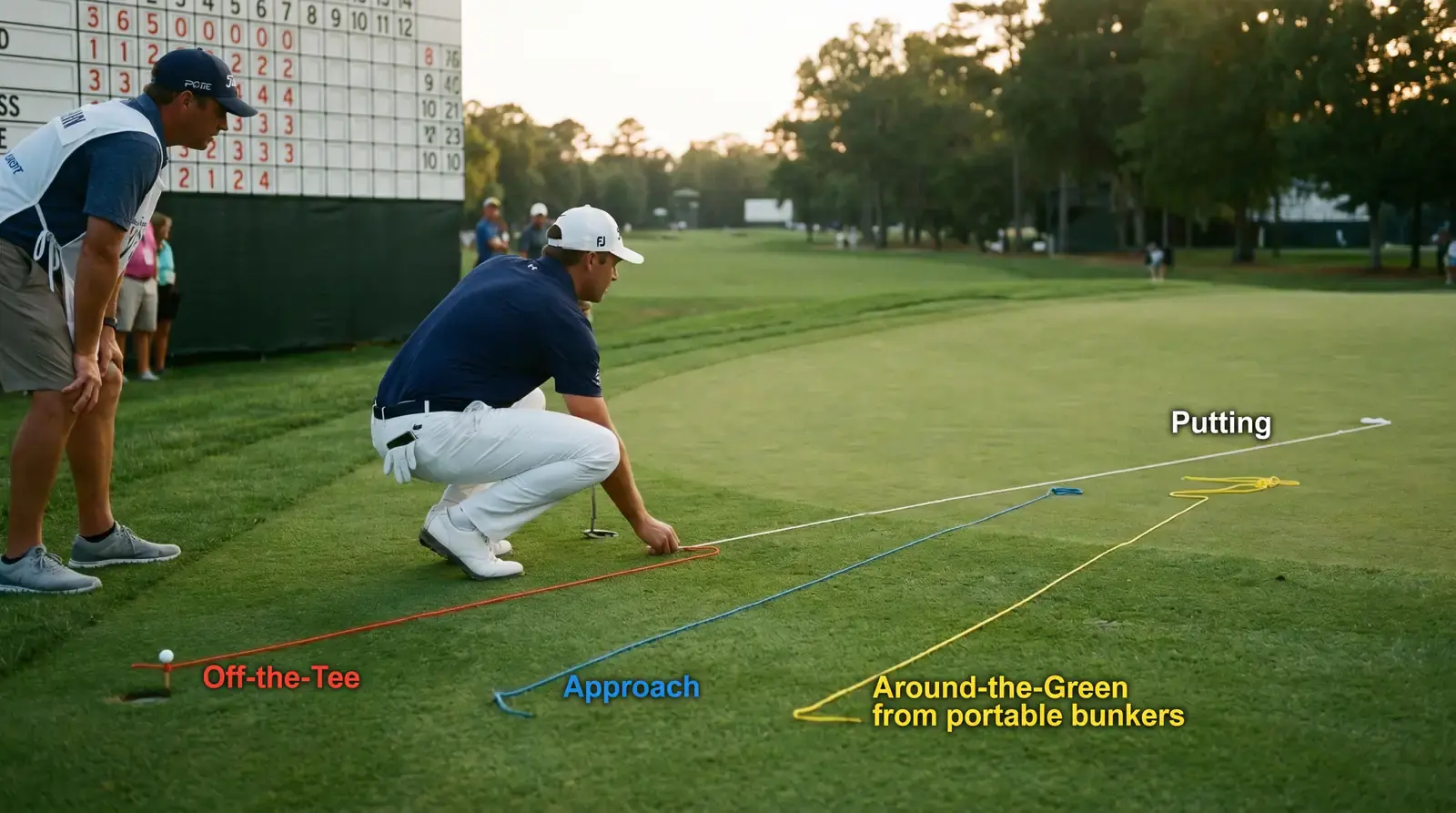
SG: Off-the-Tee measures performance from the teeing ground until the ball comes to rest, whether on the fairway, in the rough, or in a bunker. It captures both distance and accuracy. A player who averages 310 yards off the tee and finds 70% of fairways gains strokes differently from one who averages 290 but hits 80% of fairways. The metric weighs the value of each outcome — hitting it 310 into light rough might be more valuable than hitting it 280 down the middle, depending on the hole. For betting purposes, SG: OTT matters most at courses where driving accuracy is penalised harshly (thick rough, tight fairways with hazards) or where distance creates a clear advantage (long par-4s where reaching the green in two is distance-dependent).
SG: Approach measures performance on shots played from the fairway or rough into the green, excluding shots from within 30 yards. This is widely considered the most predictive category for long-term performance. A player who consistently lands approach shots closer to the pin converts more birdie putts, avoids more bogeys, and controls their scoring in a way that transcends the randomness of putting. When I assess a player before a tournament, SG: Approach is the first number I look at. It tells me how well they are striking the ball — the most reliable skill in golf.

SG: Around-the-Green covers shots played from within 30 yards of the green but not on the putting surface. Chips, pitches, bunker shots, flop shots. This category is less predictive than approach play because short-game outcomes carry more randomness — a chip that catches the fringe and kicks sideways can happen to anyone. But at specific courses where firm, undulating greens reject approach shots and leave players chipping from awkward positions, SG: ATG becomes critical. Links courses in Open Championship rotation are the classic example.
SG: Putting measures performance on the putting surface. It is the most volatile of the four categories from week to week. A player who gains 2.0 strokes putting one week might lose 1.5 the next. This volatility makes SG: Putting a dangerous metric to chase — but it also makes it valuable in-play. During a live round, if a player is draining everything from 15 feet and their SG: Putting in-round is off the charts, the market will react. The question for the bettor is whether to ride the hot putter or fade it.
Applying Strokes Gained to Live Golf Betting
Knowing the categories is table stakes. The edge comes from applying them in the right context at the right time. After years of tracking this, I have developed some firm convictions about which SG profiles matter at different stages of a tournament.

In Rounds 1 and 2, SG: Approach is king. The field is still at full strength, the course setup is fresh, and the premium is on ball-striking. Players who are gaining strokes on approach are finding greens, giving themselves birdie looks, and avoiding the scrambling situations that drain energy and confidence. My pre-tournament shortlist always starts with the top 15 in SG: Approach over the last 24 rounds at similar course types. Sportradar’s expanded partnership with Hard Rock Bet has introduced 3D shot tracking and enhanced data capabilities, meaning the granularity of approach data available for pricing has increased significantly — and that data feeds directly into how in-play odds are set.
On Saturday — moving day — the balance shifts. SG: Off-the-Tee becomes more important because the course setup typically tightens. Pin positions get harder, rough may be allowed to grow, and the premium on hitting fairways increases. A player who gained strokes through aggressive driving on Thursday and Friday might find that same aggression punished on Saturday when pins are tucked behind bunkers and the bailout areas have been mowed away.
Sunday’s final round is where SG: Putting takes over. Under pressure, with the trophy on the line, the difference between holing a six-footer for birdie and missing it for par is the difference between winning and finishing second. I do not chase week-to-week putting numbers, but I do track long-term clutch putting — specifically, strokes gained on putts inside 10 feet in final rounds. Players with strong records there handle Sunday pressure better, and the in-play market on Sunday afternoon prices putting performance more heavily than any other metric.

The PGA Tour’s VP of Gaming, Scott Warfield, has described the push toward “nimble product development” and new micro-markets that leverage granular data. Strokes gained is at the heart of that development. As golf data tools become more accessible, the punters who can interpret SG profiles in context — matching the right category to the right course on the right day — will hold a persistent edge over those still relying on world ranking and gut feeling.
Where to Find Strokes Gained Data for Betting
Access to strokes gained data has improved dramatically. The PGA Tour’s own statistics portal publishes SG data for every player on tour, broken down by category, and it is free. You can sort by current season, last 24 rounds, or specific tournament histories. The limitation is that PGA Tour stats are only available for PGA Tour events — if your player competes primarily on the DP World Tour, the SG data is thinner because the European circuit does not use ShotLink’s shot-tracking system at every event.
Data Golf is the premium paid tool that most serious golf bettors eventually adopt. It offers predictive models, course-fit scoring, custom SG filters, and a pre-tournament rankings tool that combines SG data with course history and recent form into a single output. Sportradar acquired IMG Arena in November 2025, bringing under one roof a portfolio covering 39,000 official events and 30,000 streaming events — including PGA Tour and DP World Tour data. That consolidation is expanding the data available to operators and, eventually, to punters through improved odds and markets.

For free alternatives, the PGA Tour app’s live shot-tracking feature lets you see strokes gained in-round during broadcast events. It is not as detailed as a dedicated analytics platform, but it is enough to gauge whether a player is gaining or losing strokes in real time during a live round — exactly the information you need for in-play decisions.
Why Strokes Gained Separates Informed Bettors from the Rest
Every week I see punters backing a player because he “looks in form” after a top-10 finish the previous week. Form is real, but it is also noisy. A top-10 finish fuelled by an unsustainable putting week is not the same as one built on elite ball-striking. Strokes gained strips away the noise and shows you the signal. It tells you not just what happened, but why. And in a sport where 144 players compete across 72 holes and the margins are measured in single strokes, understanding the “why” is the difference between betting with an edge and betting with hope.
Is strokes gained data available for DP World Tour events?
Partially. The DP World Tour publishes strokes gained data for some events, but coverage is not as comprehensive as the PGA Tour’s because the European circuit does not use ShotLink tracking at every tournament. Co-sanctioned events that appear on both schedules tend to have fuller data. Third-party platforms like Data Golf fill some of the gap by modelling SG estimates from available scoring data.
How do I read strokes gained data if I am new to golf analytics?
Start with SG: Total, which sums all four categories into a single number showing how many strokes a player gains or loses per round compared to the field average. A player at +2.0 SG: Total is gaining two strokes per round on the average competitor — that is elite. Then break it into the four categories to see where the gains come from. A positive SG: Approach with negative SG: Putting tells you the player is striking it well but the putter is cold — a profile that suggests the results might improve if the putting normalises.
Published by the Live Golf Betting team.